


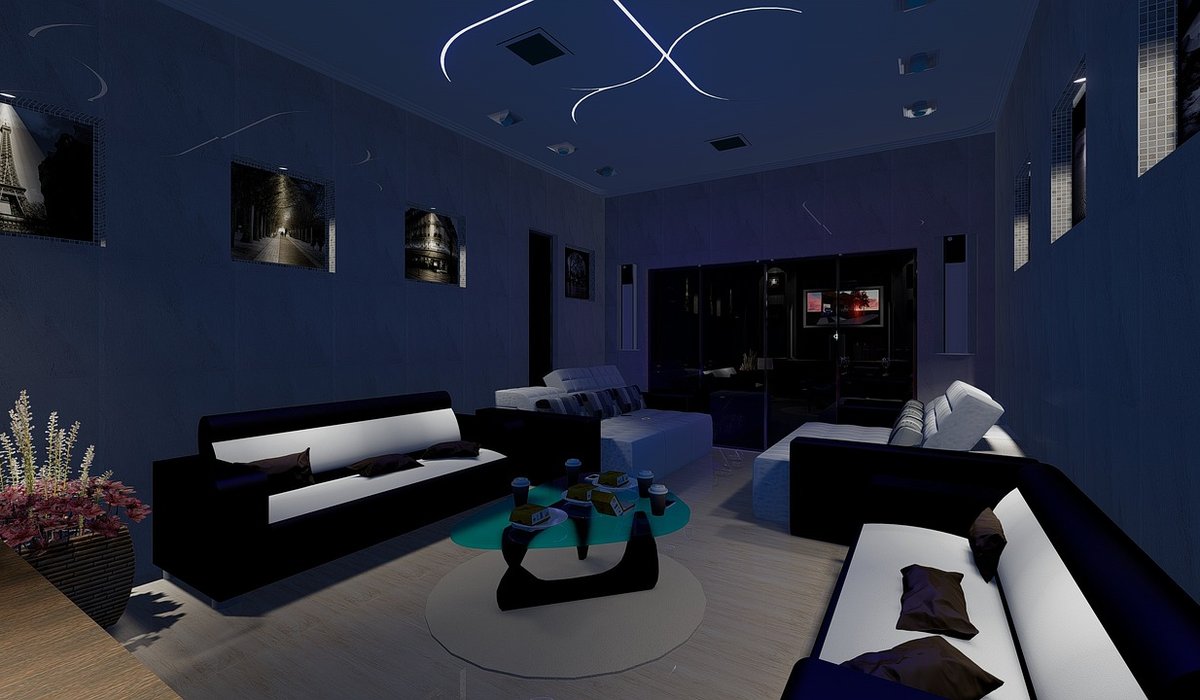
Why warm light settles a bedroom
Light has a temperature, measured in kelvin, and it quietly tells your body what time of day it is. Cool white light at 4000K and above mimics midday and encourages alertness — brilliant in a kitchen or a home office, less so when you are trying to slow down. Warm white light sits around 2700K, and the really restful stuff lives at 2200K, where the glow turns gently amber, closer to candlelight than to a ceiling panel.
If you change only one thing in your bedroom, change the colour temperature of your evening light. A room lit at 2200–2700K feels softer, kinder and noticeably easier to unwind in, without you having to think about it.
Start at the bedside
Bedside lamps do most of the heavy lifting in a bedroom scheme, so it is worth getting them right rather than grabbing whatever is on offer.
- Two lamps, one each side if you have the space. Symmetry reads as calm, and it means neither person is stuck in the dark.
- Height matters more than shape. Aim for the bottom of the shade to sit roughly level with your eyeline when you are sitting up in bed — usually a total lamp height of about 55–70cm from the floor. This stops the bulb glaring straight at you.
- Choose fabric shades in linen, cotton or a woven texture. They diffuse light beautifully. Skip bare bulbs and polished metal shades, which throw harsh hot spots.
- Fit warm, dimmable bulbs. A 4–6W LED at 2700K, roughly 250–400 lumens, is plenty for reading. Look for bulbs labelled "warm dim" or "dim to warm" if you can — these shift towards amber as you lower them.
Wall lights work just as well as table lamps if your bedside table is taken up with books. Mount them around 1.1–1.2m from the floor, and choose a design that pushes light up and down rather than outwards into your eyes.
Dimming is the single best upgrade
A dimmer switch turns one lamp into several. It is the difference between a room that is either on or off and one that breathes with the evening.
- Check compatibility. Dimmer switches and LED bulbs must be matched, or you will get flickering, buzzing or a bulb that drops out at low levels. Trailing-edge dimmers generally behave best with LEDs.
- No wiring? Use plug-in dimmers. A simple inline dimmer or a smart plug with dimming function gives you control over a standard table lamp in seconds.
- Aim for range. You want the brightest setting to be comfortable for reading and the lowest to be around 5–10% — just enough to see by as you get into bed.
- Keep controls within reach. A dimmer you have to get out of bed to adjust will never be used. A bedside dimmer, a remote or an app on your phone all work.
Layer three sources instead of one
A single overhead light flattens a room and casts shadows in all the wrong places. Layering gives you control and depth.
- Ambient: the general wash of light — a dimmed ceiling fitting, an uplighter in a corner or a floor lamp bouncing light off the walls.
- Task: your bedside lamps, bright enough to read by without lighting the whole room.
- Accent: a small lamp on a chest of drawers, a warm string of lights behind the headboard, a low lamp on a shelf. These are the ones that make a room feel inhabited rather than switched on.
Practically, this means turning the ceiling light off after dinner and letting the lamps carry the evening. If your only ceiling fitting is a bright downlight, put it on a dimmer and treat it as ambient light at 20–30%, never as your main source after dark.
Finishes, fabrics and the warm details
The materials around your light shape how warm it feels. Ivory, oatmeal and soft grey shades keep things gentle; a darker shade concentrates the beam and can feel cosier still in a larger room. Warm metals such as brass and aged bronze, plus timber, wool and linen, all sit comfortably with amber light, whereas chrome and clear glass tend to push a room cooler and brighter.
Position lamps so the light bounces off a wall or ceiling before it reaches you. This indirect approach is what gives a bedroom its soft, enveloping quality. And if you enjoy candles, remember they are the warmest light source you will ever own — around 1800K — so use them alongside your lamps rather than instead of them.
An evening lighting routine that works
The best scheme is one you actually follow. A simple rhythm looks like this:
- Early evening: ceiling light dimmed low, both bedside lamps on at around half.
- Reading or winding down: your bedside lamp up, everything else down to a glow.
- Just before sleep: one lamp at 5–10%, or a single low accent light. Then darkness.
One last thought: the bathroom light you use before bed is often the brightest in the house. A warm nightlight on the landing, or a dimmed bulb in the en suite, keeps that final half hour consistent. Get the light right and the rest of the bedroom scheme — the textures, the colours, the calm — has a chance to do its work.


Leave a reply